
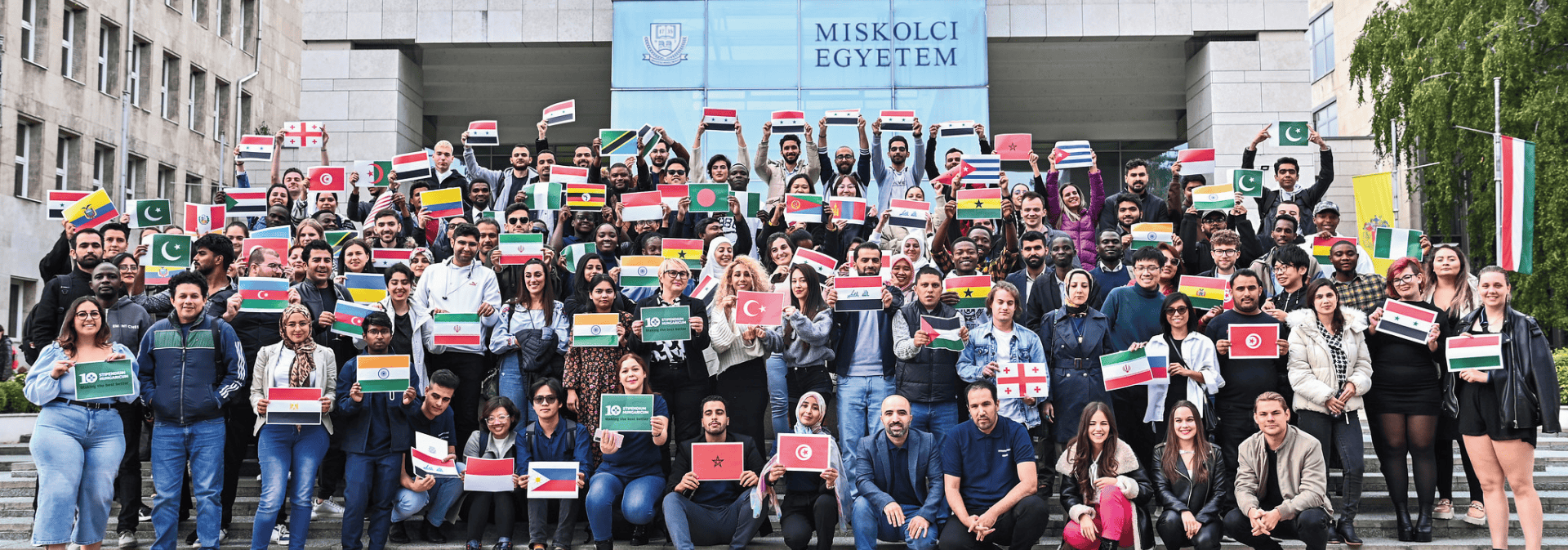

The Campus of Traditions, Knowledge and Community Spirit
A unique campus in a beautiful natural environment, up-to-date laboratories, lecture halls, workshops, dormitories and facilities for sport, culture and entertainment – this is the University of Miskolc.
Founded in 1735, as an institute of training specialists for mining and metallurgy serving as a model to many polytechnic institutes in the world, the University of Miskolc has always occupied a significant position in the cultivation of sciences, in professional education and training. During the last few decades of the 20th century, the Institution developed into a fully-fledged colourful university with the traditional three technical faculties (Earth and Environmental Sciences, Materials and Chemical Sciences, Mechanical Engineering and Informatics) and the new faculties of Economy, Law, Arts and Humanities, Health Care and Music, also courses of continuing education, or higher level vocational training. The University has approximately 10.000 students and close to 600 academic staff assisted by approximately equal number of technical and administrative employees.
Most buildings of the University can be found in Egyetemváros (‘University Town’), a unique and spacious campus, which was built in the fashion of the American campus model and it is surrounded by a large park. The University Town – with its 850.000 square meters territory – is a part of the city of Miskolc. Bartók Béla Music Institute, which was integrated into the university in 1997, can be found in the Palace of Music downtown.
The University has cooperation agreements with over 150 foreign universities, along with 160 bilateral agreements in the ERASMUS mobility programme. The University of Miskolc is the first Hungarian institution which won the ’Higher Education Quality Award’ in 2008.
The long historical traditions are combined with novel directions in research and education. The high quality of education at the University of Miskolc is demonstrated not only by the number of professional awards received, but also by the increasing interest from foreign and Hungarian students to choose the University of Miskolc for pursuing studies at the highest academic level. Our graduates are demanded by a wide scale of potential employers.
Miskolc is a city situated in North-East Hungary, and has been mostly known for its industry. It is also the seat of Borsod-Abaúj-Zemplén County and the scientific and cultural centre of the North Hungarian Region. From Miskolc, the famous Tokaj wine region is within easy reach and nice excursions can be taken to the nearby mountains and lakes, or to historical towns including Eger, Sárospatak and the beautiful Szilvásvárad.
The University of Miskolc welcomes purposeful and motivated students who aim to be qualified at a traditional yet modern and fresh academic environment

University of Miskolc, Faculty of Earth and Environmental Engineering
The history of the Faculty reaches back nearly 300 years. This in itself shows that there has been, is, and will continue to be a constant need for experts in our multifaceted discipline. Without continual development, this would not be possible. We all know that growing economies mean a greater need for the world’s raw materials, for energy and for water, and the sustainable production of these natural resources is our task.
This sector is undergoing major changes to meet changing circumstances and emerging needs of industry. Different approaches are demanded to mining. Global challenges are facing all experts, facing us and our graduates, including technologies for low CO2 emissions, the cycle economy, water as a resource, exploration and utilisation of geothermal energy, geoinformatics, new methods in raw materials exploration (both geological and geophysical), supply of strategic materials to high-tech industries, utilising materials in waste, modern raw material processing technologies, more environmentally friendly methods for mining and for the exploration and exploitation of non-conventional fossil fuels, sustainable soil management, and the effects of all of these on society and the natural environment.
Expanding and strengthening our international network is an important part of our teaching and research activities. Thanks to our international partners, our students can study in scholarship programmes abroad, and some have the opportunities to do the research for their thesis in international firms. Modern infrastructure supports our education and research. In addition to teaching, another priority is to make effective use of our research, development and innovation capabilities in grant-funded projects and in industry as well. This is seen in our particularly high participation rate in EU-funded Horizon 2020 projects and within the EIT KIC Raw Materials project; in recent years we have been awarded nearly two dozen international projects. We have also been active in serving the needs of entrepreneurial innovation through Hungarian operative research programmes.

University of Miskolc, Faculty of Materials and Chemical Engineering
In our everyday life, we are increasingly likely to encounter the special materials (such as shape memory alloys, magnetic fluids, or ceramics, metals, polymers and composites containing nanoparticles) that most people first hear about at the University of Miskolc after starting their bachelor studies at the Faculty of Materials Engineering, either in Materials Engineering or Chemical Engineering.
The centre of the Hungarian chemical industry is Miskolc and the 30-kilometre area surrounding it, which includes Kazincbarcika (BorsodChem), Sajóbábony (KISS Group) and Tiszaújváros (MOL MPK) – a region where the demand for well-trained professionals is growing. Our graduate engineers have a wide range of attractive job opportunities to choose from, as engineers are in short supply. Young people with high-quality technical skills and ambition are sought both in Hungary and abroad.
The University of Miskolc is at the forefront of dual training nationwide, with the largest number of dual partner companies per bachelor’s degree in the country, and students can choose from nearly 60 companies. The large number of companies that have joined our dual training programme shows the value and prestige of the diploma we offer.
The faculty, with its centuries-old historical tradition, offers the high level of knowledge expected in the 21st century so that our students can become professionals with a great future. If this opportunity appeals to you, apply to the Faculty of Materials and Chemical Engineering. We look forward to welcoming you!


Tradition
The facultyies were founded in 1735 under the name of “Berg-schola”, and its success enabled Empress Maria Theresa to elevate the institution to the status of a higher education institution on 22 October 1762 under the name of “Academia Montanistica”. The term covered both mining and metallurgy. In the 18th century, the transport of mined ore was difficult, so smelters were set up right next to the mines. The Academy was a well-known and sought-after centre for mining, metallurgy and related sciences throughout Europe.
The Selmecbánya Academy has a colourful student tradition. As the academy was unique, almost all students came from far away. Experienced, older students helped the younger ones to manage in these new surroundings. Of course, this meant “testing” whether the newcomer was worthy of trust. This was and still is the purpose of the “balek” education, with a few jokes and pranks thrown in, because serious rules cannot exist without fun. Examinations and initiations of new members, shared entertainment and singing together are typical features. The students shaped the customs to their own taste, dropping and adding things. Of course, life was not all fun and games. They formed their own aid societies to support needy students. They held charity balls and get-togethers and nursed their sick peers, sometimes donating blankets, pillows or firewood. They also paid for the funerals of their deceased companions. Over the decades, traditions have changed, but the main point remains the same: to love your vocation, to help your fellow students and to live as happy a student life as possible.
The century old traditions are mainatined with the help of the (angol név: OMBKE)
Organized by


